
Featured Articles

Mission Statement
To place Beagles in need into
loving, permanent homes and to provide educational resources to help
prevent future displaced Beagles.
Our program is funded by private
donations. Your support is appreciated!
April 2006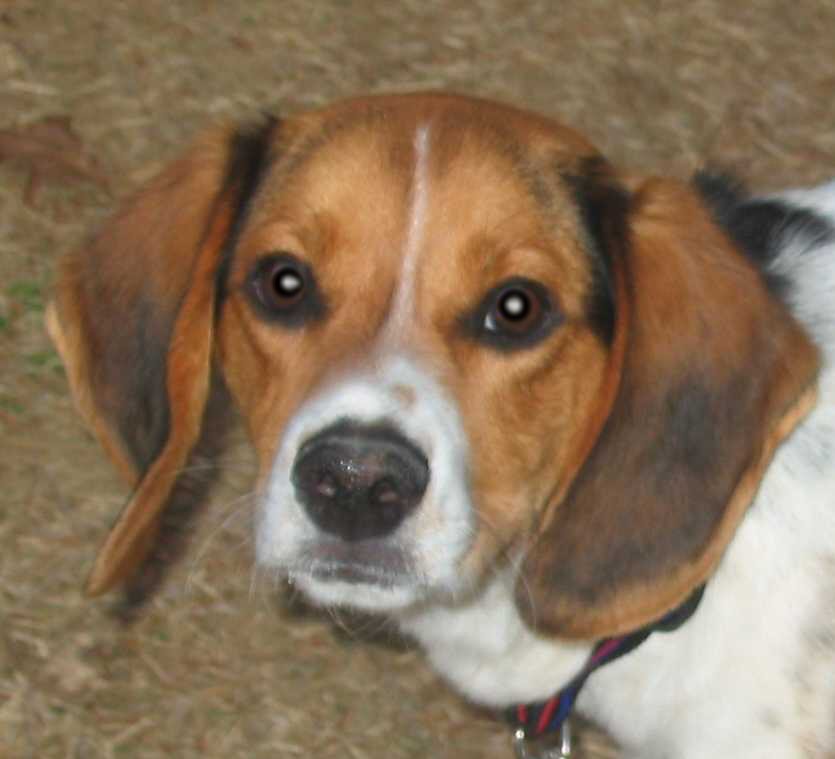
The Health Column
Kennel Cough
One evening, not long ago, Rascal started coughing and hacking, as if he had something caught in his throat. It was a dry sounding "cough," more like a retching or gagging, but with nothing coming out/up. Rascal loves to "shred" plastic dog toys into small, sharp-edged pieces, extremely hazardous to the bare human foot. He does not ever swallow these pieces; however, it seemed within the realm of possibility that he had somehow inhaled/swallowed one by mistake, and now it was lodged in his throat and he couldn’t get it out. I looked and felt down in his throat but saw and felt nothing. So I gave him some honey, in an attempt to coat/soothe his throat and get rid of whatever was bothering him. After a very sleepless night, he was still having coughing fits about every four hours. So he visited the vet, who asked if he had been boarded recently (he hadn’t) or been around other dogs (he lives with two other dogs, neither of whom were sick). After examining Rascal and seeing/feeling nothing in his throat, the vet diagnosed an "irritation" of the throat and prescribed antibiotics, which I politely refused.
Later I realized of course he has been around other dogs--we attend obedience classes each week and had been to an agility workshop just a week earlier. Further research led me to believe that Rascal’s symptoms were pointing to Kennel Cough, although it was never officially diagnosed. The following article summarizes my research into this illness, including natural treatments and prevention.
Kennel cough is a fairly common ailment in dogs. People tend to associate it with dogs who either are being or recently have been boarded (or "kenneled"). But your dog need not be boarded to catch kennel cough. Kennel cough is caused by an airborne virus, which is highly contagious. Any time your dog is in the vicinity of an infected dog, the potential exists for infection. The incubation period is about 8-10 days, meaning your dog will not display symptoms of illness for about 8-10 days following exposure to the virus. Having a strong immune system is best way to avoid coming down with symptoms if/when your dog is exposed to the virus. This is why not every dog in the kennel (or house) will get it if there is an outbreak.
Although there is a vaccine (Bordatella) for Kennel Cough, it is often not effective in preventing infection. The most likely explanation for this is that there are many strains and mutations of the virus out there. Therefore, it is hit or miss whether the vaccine used on your dog will be the right one for the strain with which your dog comes into contact. This is similar to the "flu shot" for people; each year a vaccine is developed based on which strain(s) are suspected to be most prevalent. Be aware that your dog can still catch Kennel Cough even if s/he has had a shot to prevent it.
The usual symptoms of Kennel Cough include a dry, "non-productive" cough. The dog sounds as if there is something stuck or caught in the throat and the coughing is an unsuccessful attempt to dislodge the object. Sometimes the coughing/gagging seems very violent. The episodes of coughing may go on for minutes at a time and then be repeated at intervals. Of course you will want to check your dog and make certain that there isn’t anything actually stuck in the throat! One way you can "test" for Kennel Cough is to press the throat gently, right in the collar area. If the dog has Kennel Cough, this will probably trigger some coughing.
If your dog does develop Kennel Cough symptoms, don’t panic! The way this illness operates is analogous to the common cold that we humans sometimes catch; simply put: it must run its course. There is no magic pill or cure, but there are many ways to treat and ease the symptoms. The goal is to support the body (immune system) while it is healing itself. Antibiotics are not indicated (although they are routinely prescribed and used) because this is a virus, not a bacteria. Antibiotic use is actually thought to slow the healing process. Kennel cough generally will be gone in two weeks time or less, with or without antibiotics (but probably faster without).
Here are some ideas for natural treatments you may use to treat your dog’s Kennel Cough symptoms. None of these will harm your dog in any way, even if s/he does not even have Kennel Cough, but you may want to check with your own vet before giving them to your dog.
For boosting the immune system and fighting off infection:
Vitamins:
 500 mg Vitamin C 3x/day (250 mg for
tiny dogs) (If you already supplement with vitamin C, great! But this is
in addition to the regular daily dose, and is spaced out during the day.)
500 mg Vitamin C 3x/day (250 mg for
tiny dogs) (If you already supplement with vitamin C, great! But this is
in addition to the regular daily dose, and is spaced out during the day.)
Herbal tinctures:
Echinacea (give a few drops, 3x/day, either directly into the mouth or on
food)
Goldenseal (same instructions as Echinacea)
Other:
Colloidal Silver (Give just a drop or two, 3x/day. May be mixed with food
or put into drinking water.)
For directly combating the Kennel Cough virus:
Homeopathic Remedies:
Bryonia (give 1-2 pellets/tablets 3x/day; allow no food for ten minutes
before and after the dose. Most health food stores sell homeopathic
remedies in the 6X or 6C potency, which is fine to use. If you have a
choice of potencies, ask for 30C, which is a bit stronger. Homeopathy
works when the correct remedy is matched to the correct symptoms,
regardless of the potency of the remedy.)
Drosera (same instructions)
For soothing throat irritation:
Honey (about a teaspoon for a small-med dog, a tablespoon for a larger
dog, 3x/day)
Eliminate exposure to second hand smoke.
Maintain humidity in the environment.
If you have more than one dog in your household, and one of them develops Kennel Cough, you can try to keep that one isolated, to minimize exposure to your other dog(s). However, by the time your dog is symptomatic, the virus has probably already been "shared" with your other pets or any other dogs with which yours has had contact recently. You may wish to treat all of your dogs, as a preventive measure for those that are asymptomatic, to ensure their immune systems are strong enough to ward off infection from the virus. Also, it would be good pet ownership to refrain from taking your ill dog to obedience class, dog shows, or any other dog-related event until s/he has recovered.
As for Rascal, he was treated with a combination of colloidal silver, honey, Echinacea, goldenseal, vitamin C and drosera. After the second day, all coughing fits ceased. Rascal was back to his perky, sassy self in a matter of days. My other two dogs were given colloidal silver in their drinking water as a preventive measure, and neither developed any symptoms.
This article written by J. Boniface, (c)
copyright 1998, all rights reserved. Reprinted with
permission from
http://www.auntjeni.com/index.html
Disclaimer:
Links are meant as a convenience to the reader not as an endorsement nor
does CBR guarantee any products and/or services offered on any linked
pages. Always trust your own veterinarians advice with regard to your
pets health and use your own judgement when deciding a course of
treatment.
Click
here to visit the article archives.
Mission Statement
To place Beagles in need into
loving, permanent homes and to provide educational resources to help
prevent future displaced Beagles.
Our program is funded by private
donations. Your support is appreciated!